
• +1 502-690-2200
  • This email address is being protected from spambots. You need JavaScript enabled to view it.

Awhey with sarcopenia

Awhey with sarcopenia

I have written many articles covering research that investigates the effects of nutrition and exercise interventions on muscle growth, with some specifically addressing the elderly population. In these latter studies, it has been shown that low-intensity resistance training maintains anabolic signaling in skeletal muscle and leads to increases in muscle mass, and that adding even a meager 25 grams of whey protein to the diet can increase lean body mass without any other intervention. But these above referenced studies only manipulated one thing at a time, and neither of them were performed in an elderly population suffering from sarcopenia – which is a group that needs muscle-building interventions more than anything. Thankfully, we have the work of Rondanelli et al that puts these puzzle pieces together in a recent randomized, double-blind, placebo-controlled supplementation trial. Specifically, 130 DXA-confirmed sarcopenic elderly men and women admitted to the geriatric physical medicine and rehabilitation division...

Continue reading
  3137 Hits

The causal role of breakfast in obesity

The causal role of breakfast in obesity


Effective fat loss strategies are necessary for individuals with obesity and other conditions in which excessive fat tissue may pose a health risk. One commonly recommended strategy is to eat breakfast, and there has been a tremendous amount of research investigating the effects of eating various types of breakfasts on satiety, metabolism, and health. Yet, there has also been an increasing number of studies showing that breakfast is not king. For instance, in August of 2014, David Levitsky from Cornell University published an editorial where he rightly pointed out that breakfast is the most important meal of the day only if you are selling breakfast cereals. This editorial was spurred in part by research examining the effects of breakfast consumption or omission on all components of energy balance and health in lean men and women over the course of six weeks. The results of which showed that there are no metabolic...

Continue reading
  2110 Hits

Chewing gum, the next best dieting aid?

Chewing gum, the next best dieting aid?


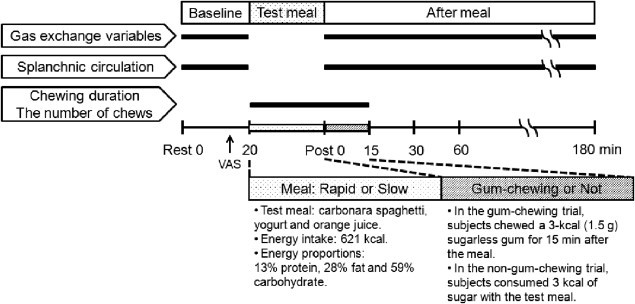
I would never have guessed that chewing a piece of sugar-free gum after eating could boost diet-induced thermogenesis (DIT) and fat oxidation. I’m of course talking about the 25-50% increase in DIT observed in a small group of healthy men from Hamada et al’s latest study in the journal Obesity. These researchers recruited 12 healthy, normal-weight young men and had them complete four experimental trials in a randomized crossover design (figure 1). Each trial involved 20 minutes of baseline measurements (gas-exchange variables, splanchnic circulation, and blood samples), followed by consuming a test meal as rapidly or slowly as possible, and completed with 180 minutes of post-meal measurements. Additionally, for 15 minutes after finishing the test meal, 3 kcal of sugar-free gum was chewed or 3 kcal of sugar was consumed. Accordingly, the four trials were rapid-eating with gum (RG), rapid-eating without gum (RN), slow-eating with gum (SG), and slow-eating without gum...

Continue reading
  4639 Hits

The satiety effect: protein > carbs > fats

The satiety effect: protein > carbs > fats


It’s common knowledge that protein is the most satiating macronutrient, and there is bountiful research to support this conclusion. Yet, most all of this research has one major caveat: the content of two macronutrients is varied while the third is held constant. After all, you can’t change the protein content of a meal without changing its fat or carbohydrate content, at least not if you want calories to remain equal. The problem with this approach is that is prevents definitive conclusions about what caused what. Was it the increase in protein that reduced appetite, or was it the simultaneous reduction in carbohydrates or fats? We can of course make sound conclusions based on the literature as a whole, which is how we arrived at our current belief that protein is the most satiating macronutrient. But the keystone study that shows without a doubt that protein is king when you want to...

Continue reading
  3432 Hits

Diets fast and slow; what is the best for maintaining muscle and energy expenditure?

Diets fast and slow; what is the best for maintaining muscle and energy expenditure?

Assuming all else equal, would a person who weighs 180 lbs have greater energy expenditure than a person who weighs 150 lbs? The answer is yes, because the heavier individual has more body mass that not only requires calories to sustain at rest but also adds resistance (weight) during movement. What if the 180 lb person was overweight-obese and decided to diet down to 150 lbs? His energy expenditure would be reduced for the same reasons just mentioned. In general, the loss of body mass is the largest determinant of the reduction in energy expenditure, but it is not the only determinant.

Continue reading
  2026 Hits
SHR Logo

Super Human Radio is the world's longest running broadcast dedicated to health, fitness & anti-aging with an emphasis on exercise, nutrition, and hormone management. This one of the most progressive podcasts for preventative & regenerative techniques designed to increase longevity. More

2908 Brownsboro Rd Ste 103
Louisville, Kentucky 40206

(502)-690-2200

SHR Logo

Super Human Radio is the world's longest running broadcast dedicated to fitness, health, and anti-aging with emphasis on exercise, nutrition, and hormone management. The most progressive source of information for preventative & regenerative techniques... More

2908 Brownsboro Rd Ste 103
Louisville, Kentucky 40206
United States of America

+1 502-690-2200