
• +1 502-690-2200
  • This email address is being protected from spambots. You need JavaScript enabled to view it.

Cardio-protective effects of fish are not owed entirely to fish oils

Cardio-protective effects of fish are not owed entirely to fish oils
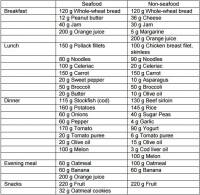
Sample daily menu of experimental diets
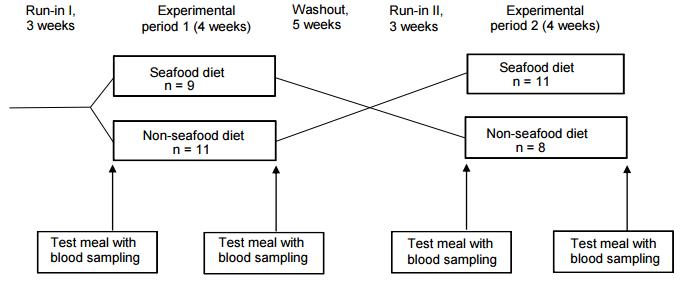
Experimental protocol
Cardio-protective effects

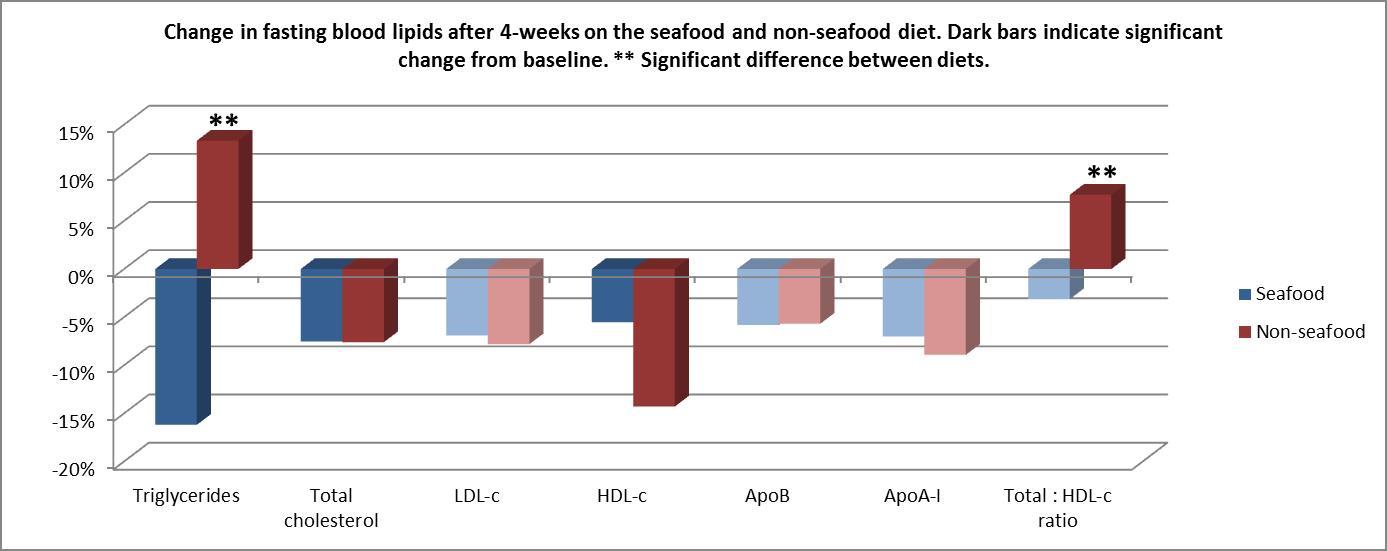
Fish and fish oils are one of the few foods that appear to be universally accepted as healthy, and a massive analysis of all published meta-analyses and systemic reviews from 1950 to 2013 found fish consumption to be one of the most protective food groups against all diet-related chronic diseases, especially cardiovascular disease (CVD). Much of the focus has, however, been on fish oils and the fatty fish that contain them in appreciable quantities. But what if there are other aspects to fish that make it beneficial? Preliminary findings have suggested, for example, that the addition of fish gelatin to a fish oil supplemented diet enhances the cardioprotective effects. To answer this question, researchers from the National Institute of Nutrition and Seafood Research, Norway, recruited 19 healthy middle-aged Caucasian men and women from the local area to participate in a crossover design RCT comparing identical diets differing only in their primary...


Continue reading
  2001 Hits

How much protein should I eat?

How much protein should I eat?
Christian Bale's 1-year transformation for
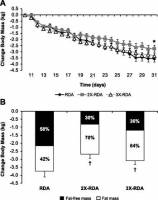
Changes in body composition in dieters (40% deficit) consuming 0.8 (RDA), 1.6 (2X-RDA), and 2.4 (3X-RDA) g/kg BW protein
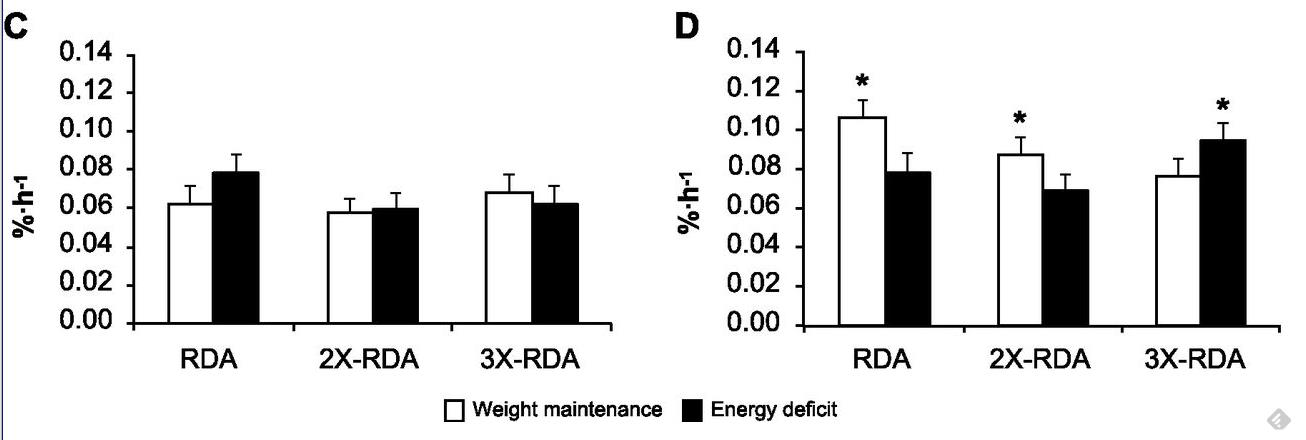
Postabsorptive (fasting) muscle protein synthesis (C) and postprandial muscle protein synthesis (D) responses to varying levels of dietary protein intake.
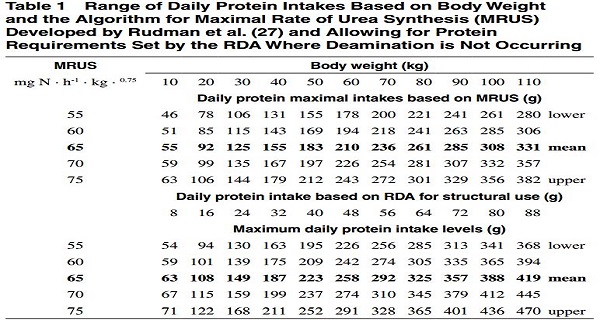
Range for theoretical protein intake at different bodyweights before toxicity would occur based on Rudman's work.

Protein is arguably the most important macronutrient we eat, and all the protein we accrue within the body is in the form of muscle, organs, and countless of other essential compounds. In fact, the typical human cell is roughly one-fifth protein by mass. Unlike carbohydrates and fat, there is no storage form of protein on the body that sits around waiting to be used – every single amino acid plays an important role in our wellbeing. Although it may not necessarily be healthy, the body can survive indefinitely without carbohydrate intake and for a very long time with little to no fat intake. On the other hand, insufficient protein intake leads to rapid death. Generally speaking, all tissues in the body are under a state of constant remodeling via protein breakdown and synthesis. These processes are distinct physiological pathways (not simply the reverse of one-another) and their relationship can be referred...

Continue reading
  8388 Hits

Super Human Roundup: Smoking and energy expenditure; national protein sources, and why we yo-yo diet

Super Human Roundup: Smoking and energy expenditure; national protein sources, and why we yo-yo diet

Smoking is associated with increased resting energy expenditure Cigarette smoking is known to be associated with lower bodyweight and weight gain is a common feature of smoking cessation. It is believed that nicotine acts by various mechanisms on the body’s energy balance and affects both the central nervous system and peripheral tissues by regulating the release of a wide range of neurotransmitters and hormones. Now, Blauw et al show in the first large-scale cohort of its kind that smokers have a 4.7% higher resting energy expenditure per kilogram of fat-free mass than never smokers. This result came from analysis of 1189 men and women from the Netherlands Epidemiology of Obesity (NEO) study. Where do we get our protein? According to Pasiakos et al from the US Army Research Institute of Environmental Medicine, who analyzed the NHANES 2007-2010 data on 10,977 adults, the average protein intake from animal, dairy, and plants was...

Continue reading
  1697 Hits

Reanalysis confirms, more protein maximizes fat loss in overweight adults

Reanalysis confirms, more protein maximizes fat loss in overweight adults
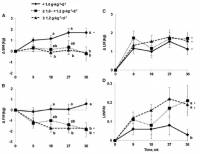
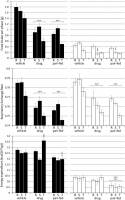
Changes in bodyweight (A), fat mass (B), lean-body mass (C), and the lean to fat mass ratio (D) every 9 weeks throughout the intervention. *Significantly different from zero (i.e., the change from before to after the intervention is significant). Values without a common letter are significantly different.
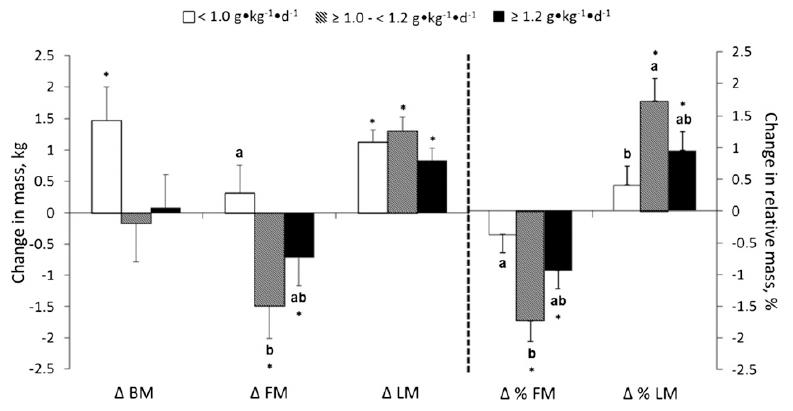
The changes in BM, FM, LM, %FM, and %LM; * significantly different from zero (i.e., the change from before to after the intervention is significant). Values without a common letter are significantly different.

In 2012, researchers from Purdue University published a study suggesting that increasing total protein intake through whey protein supplementation was not effective in enhancing exercise-induced improvements in body composition and indices of metabolic syndrome in middle-aged overweight and obese adults. In this double-blind, randomized, placebo-controlled, community-based study, 220 inactive adults [about half of which had metabolic syndrome (MetS)] completed a 9-month resistance training (2 d/wk) and aerobic training (1 d/wk) exercise program that ultimately led to increases in whole-body strength and VO2max and an increase in lean-body mass (LBM) and reduction in fat mass (FM) despite no bodyweight change. However, during this intervention period, the participants were also instructed to consume a 200 kcal sachet twice daily with breakfast and lunch that contained 0, 10, 20, or 30 g whey protein (total daily supplemental dose 400 kcal and 0, 20, 40, and 60 g whey, respectively), which had no impact on...

Continue reading
  1777 Hits

Leptin research update: It’s not just the weight loss but the dieting that suppresses leptin, and leucine may be the hero


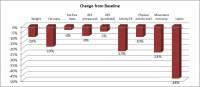
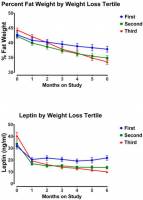
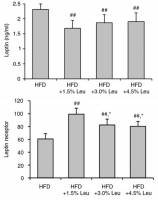
Energy restriction and weight loss lead to several fundamental changes in physiology that make weight regain easy and continued dieting more difficult. A lot of it comes down to the p-ratio of the dieting individuals, but one hormone that is central to the puzzle is leptin. That is because leptin levels decline both during dieting and after there is a return to caloric maintenance regardless of the weight-loss protocol. The suppression post-dieting is one aspect that makes maintaining a lower body weight so difficult. Interestingly, administration of exogenous leptin during this time has been shown to reverse the reduction in energy expenditure, the reduction in neuromuscular adaptations, and the increased food-reward cues. This begs the question, to what extent does leptin influences these changes? The answer comes from the work of Stefan Camps at Maastricht University, the Netherlands. He and his colleagues recruited 82 obese but otherwise healthy middle-aged men and...

Continue reading
  3061 Hits

Super Human Roundup: Protein and fish oil for the old, apples and oatmeal for the young, and 3 eggs or nothing because 1.5 doesn’t cut it

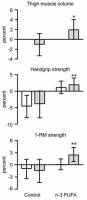
Changes in thigh muscle volume, handgrip strength, and 1-RM muscle strength in the n-3 PUFA and control groups.
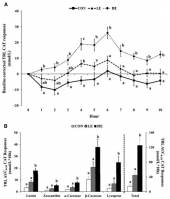
Total carotenoid content of the blood lipoproteins  for the ten hours after eating a salad (control) with 1.5 eggs (LE) or 3 eggs (HE).

Every day new research is published and the unfortunate truth is that it would be impossible for me to write an article on everything I come across. Plus, in all fairness, not every study deserves a full article. Therefore, I decided to write a weekly Super Human Roundup series that briefly touches on some of the research I can’t or don’t want to address in length. This way you don’t miss out on anything that may interest you. Sahni et al. from Harvard Medical School was interested in understanding the role of dietary protein on muscle mass and strength in older adults. They looked at data on over 2600 men and women from the Framingham Offspring Study who had valid dietary assessments and measurements of quadriceps strength and body composition (DXA). The subjects averaged 60 years of age and statistical adjustments were made for age, height, total energy intake, physical activity,...

Continue reading
  1900 Hits
SHR Logo

Super Human Radio is the world's longest running broadcast dedicated to health, fitness & anti-aging with an emphasis on exercise, nutrition, and hormone management. This one of the most progressive podcasts for preventative & regenerative techniques designed to increase longevity. More

2908 Brownsboro Rd Ste 103
Louisville, Kentucky 40206

(502)-690-2200

SHR Logo

Super Human Radio is the world's longest running broadcast dedicated to fitness, health, and anti-aging with emphasis on exercise, nutrition, and hormone management. The most progressive source of information for preventative & regenerative techniques... More

2908 Brownsboro Rd Ste 103
Louisville, Kentucky 40206
United States of America

+1 502-690-2200