
• +1 502-690-2200
  • This email address is being protected from spambots. You need JavaScript enabled to view it.

Proteinaholic Rebuttal

Proteinaholic Rebuttal

Howard, I applaud you for co-authoring the book Proteinaholic and approaching the Super Human Radio interview with a combination of open-mindedness, thoughtfulness, and skepticism. You were a joy to listen to and I believe that we need more individuals such as yourself promoting the diversity of thought that Proteinaholic brings to light. While the bulk of this letter addresses certain topics that we do not see eye-to-eye on, I want to start by highlighting the numerous points of agreement that were brought up throughout the hour interview. The irony with these, of course, is that they have little to nothing to do with protein. 1)      All humans in the world are the same species and we will therefore have a fundamental dietary pattern that best suits our needs. At the core, this will be a whole-foods, plant-based diet without all the processed crap (can I say that on here?). 2)      The...

Continue reading
  7562 Hits

How much protein should I eat?

How much protein should I eat?
Christian Bale's 1-year transformation for
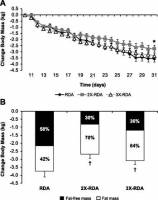
Changes in body composition in dieters (40% deficit) consuming 0.8 (RDA), 1.6 (2X-RDA), and 2.4 (3X-RDA) g/kg BW protein
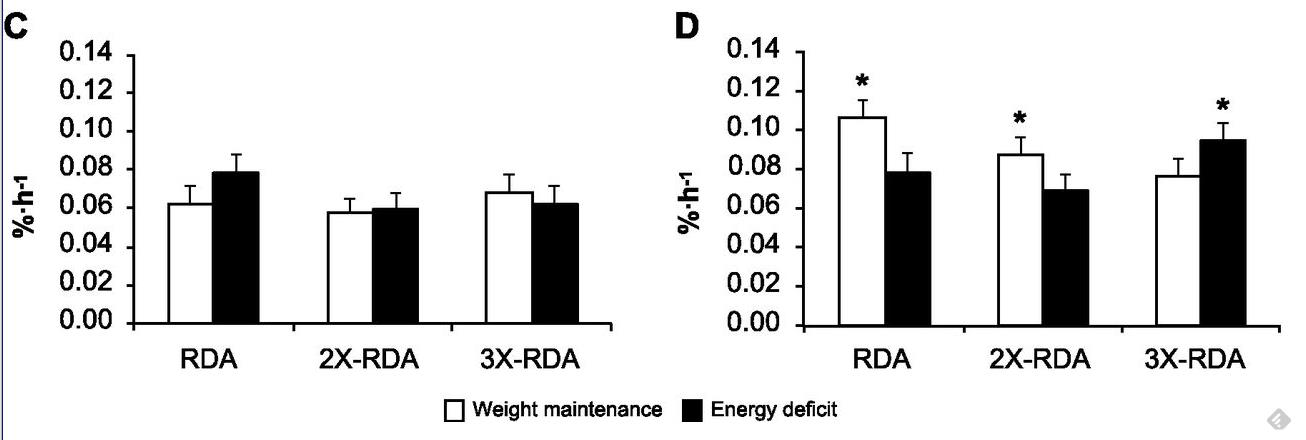
Postabsorptive (fasting) muscle protein synthesis (C) and postprandial muscle protein synthesis (D) responses to varying levels of dietary protein intake.
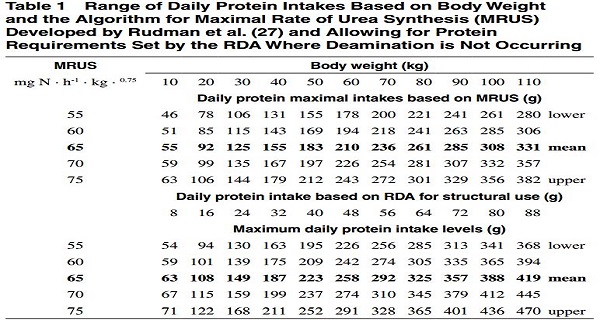
Range for theoretical protein intake at different bodyweights before toxicity would occur based on Rudman's work.

Protein is arguably the most important macronutrient we eat, and all the protein we accrue within the body is in the form of muscle, organs, and countless of other essential compounds. In fact, the typical human cell is roughly one-fifth protein by mass. Unlike carbohydrates and fat, there is no storage form of protein on the body that sits around waiting to be used – every single amino acid plays an important role in our wellbeing. Although it may not necessarily be healthy, the body can survive indefinitely without carbohydrate intake and for a very long time with little to no fat intake. On the other hand, insufficient protein intake leads to rapid death. Generally speaking, all tissues in the body are under a state of constant remodeling via protein breakdown and synthesis. These processes are distinct physiological pathways (not simply the reverse of one-another) and their relationship can be referred...

Continue reading
  8388 Hits

Can’t walk? Resistance training saves muscle from sedentariness

Can’t walk? Resistance training saves muscle from sedentariness
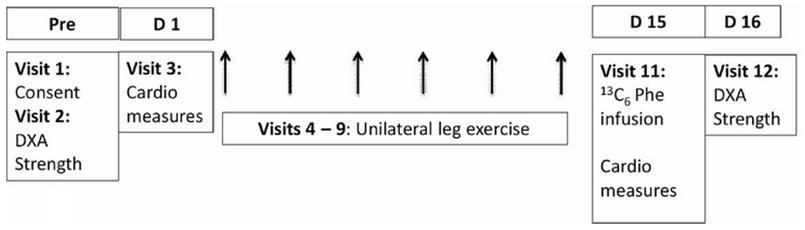
Study Outline
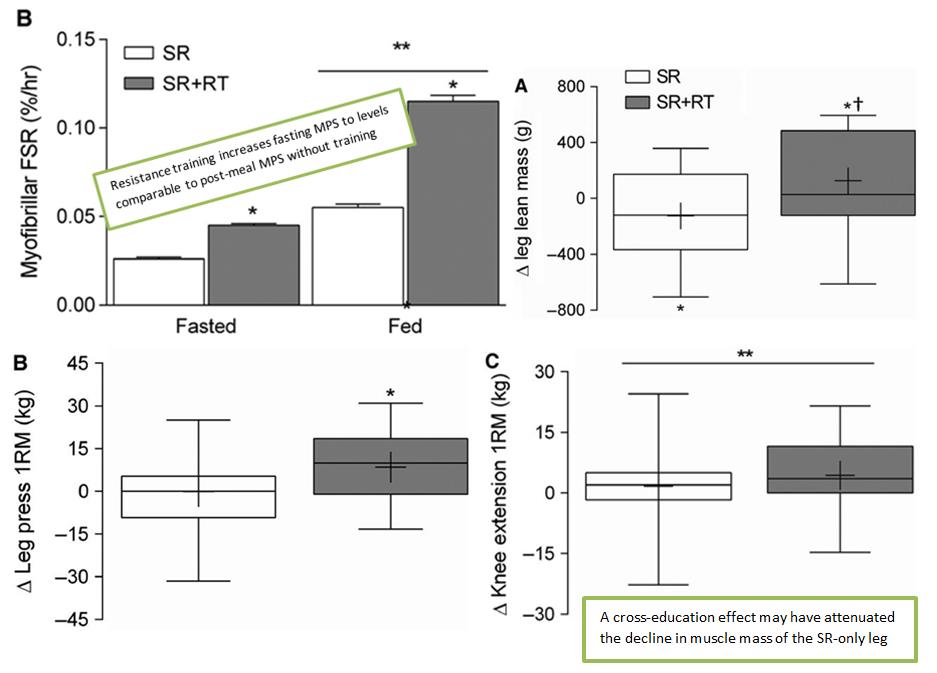
Changes in muscle protein synthesis, leg muscle mass, and leg strength after 2-weeks step reduction with (SR+RT) or without (SR) resistance training.

Generally speaking, with age comes a natural loss of muscle mass and function that is owed in no small part to a reduction in physical activity. This may be because protein metabolism is greatly influenced by the contractile activity of skeletal muscle, and it has been shown that muscular disuse results in a reduction in muscle protein synthesis (MPS) both after a meal and when in the fasting state. Even modest reductions in muscular loading through step‐reduction (SR; <1500 steps/day) for 2-weeks has been shown to reduce MPS in older adults, further supporting the notion that sedentariness plays a large role in the anabolic resistance of aging. Somewhat obviously, resistance training (RT) is the foundation of any intervention that seeks to counteract muscle and strength loss, and there is no shortage of evidence showing older individuals to benefit. However, many interventions use high-load programs that may not always be feasible for...

Continue reading
  2919 Hits

Reanalysis confirms, more protein maximizes fat loss in overweight adults

Reanalysis confirms, more protein maximizes fat loss in overweight adults
Changes in bodyweight (A), fat mass (B), lean-body mass (C), and the lean to fat mass ratio (D) every 9 weeks throughout the intervention. *Significantly different from zero (i.e., the change from before to after the intervention is significant). Values without a common letter are significantly different.
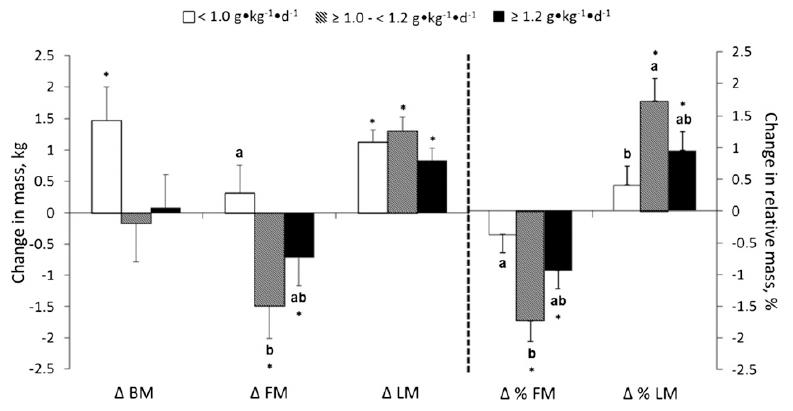
The changes in BM, FM, LM, %FM, and %LM; * significantly different from zero (i.e., the change from before to after the intervention is significant). Values without a common letter are significantly different.

In 2012, researchers from Purdue University published a study suggesting that increasing total protein intake through whey protein supplementation was not effective in enhancing exercise-induced improvements in body composition and indices of metabolic syndrome in middle-aged overweight and obese adults. In this double-blind, randomized, placebo-controlled, community-based study, 220 inactive adults [about half of which had metabolic syndrome (MetS)] completed a 9-month resistance training (2 d/wk) and aerobic training (1 d/wk) exercise program that ultimately led to increases in whole-body strength and VO2max and an increase in lean-body mass (LBM) and reduction in fat mass (FM) despite no bodyweight change. However, during this intervention period, the participants were also instructed to consume a 200 kcal sachet twice daily with breakfast and lunch that contained 0, 10, 20, or 30 g whey protein (total daily supplemental dose 400 kcal and 0, 20, 40, and 60 g whey, respectively), which had no impact on...

Continue reading
  1777 Hits

Super Human Roundup: Nine weeks for gains, taxing soda, and why we go to war

Nine weeks of dedicated for the elderly to see progress If you train long enough, your bound to build muscle eventually. Just how long was recently investigated by researchers from Brazil who recruited elderly men and women to undergo a 10-week resistance training (RT) program with workouts twice per week, no structured physical activity (control). Initially, the subjects warmed-up in a stationary bicycle for five minutes. Afterwards, subjects performed 4 sets x 10 repetitions with a 1-min rest interval between sets in a 45° leg press machine (G3-PL70 MATRIX, São Paulo, Brazil). In the first five weeks of training the exercise intensity was set at 70% 1-RM, based on the pre-test values; for the last five weeks, exercise intensity was increased to 80% of the re-tested 1-RM (assessed at the middle of the RT period). The range of motion at the knee joint during the leg-press was set to ~ 90°....

Continue reading
  1679 Hits
SHR Logo

Super Human Radio is the world's longest running broadcast dedicated to health, fitness & anti-aging with an emphasis on exercise, nutrition, and hormone management. This one of the most progressive podcasts for preventative & regenerative techniques designed to increase longevity. More

2908 Brownsboro Rd Ste 103
Louisville, Kentucky 40206

(502)-690-2200

SHR Logo

Super Human Radio is the world's longest running broadcast dedicated to fitness, health, and anti-aging with emphasis on exercise, nutrition, and hormone management. The most progressive source of information for preventative & regenerative techniques... More

2908 Brownsboro Rd Ste 103
Louisville, Kentucky 40206
United States of America

+1 502-690-2200